

From Kaggle competitions to Claude Code subscriptions
A philosophical detour through AI slop, developmental bypass, and why slang matters more than your textbooks
When everyone can build, what is valuable?
I spent years debugging vanishing gradients in deep neural networks. Now a PM with a Claude Code subscription ships entire apps before lunch.
I'm not bitter. I've been in data science for two decades — bioinformatics and deep learning research, consultancy for big companies, AI leadership. What's happening is genuinely extraordinary. But it forces a question most of us avoid: if everyone can build, what's actually valuable?
The question of what makes something valuable has haunted economists for centuries. Is it the labor you put in? The scarcity of the skill? The market's willingness to pay? When AI can generate in seconds what took us years to learn, all three shift at once. But this isn't collapse — it's reallocation. Schumpeter called it creative destruction: capitalism's engine for turning today's premium skill into tomorrow's commodity, freeing human energy for whatever comes next (Capitalism, Socialism, and Democracy, 1942). It's how we got from agriculture to industry to knowledge work. Each time, the transition felt like loss. Each time, what emerged was more valuable than what disappeared. AI is the latest wave. The question isn't whether it destroys old value — it will. The question is what new value emerges on the other side, and whether you're building toward it.
Drowning in output: welcome to the slop age
The data on what mass-produced AI output actually looks like is now definitive.
A 2026 study analyzing 8.1 million PRs from 4,800 teams found AI-generated code contains 1.7x more issues than human code, with technical debt rising 30–41% within 90 days of adoption. 2026 benchmarks show code complexity growing 3.28x and static analysis warnings up 4.94x in some environments. An arXiv paper from March 2026 tracking AI-authored commits across real repositories found over 110,000 surviving AI-introduced issues accumulating by February 2026 — debt that becomes permanent maintenance burden.
Incidents per PR are up 23.5%. Change failure rates up 30%. PRs wait 4.6x longer for review because reviewers can't keep up with volume. The estimated quality deficit for 2026 is 40% — the gap between code generated and code properly reviewed.
But slop isn't just code. LinkedIn drowns in AI-generated thought leadership that says nothing. Medium fills with SEO-optimized articles that rank well and inform poorly. A 2025 study in JMIR Medical Education found growing AI "slop" in educational videos — what researchers formally defined as "careless speech," produced without genuine attention. AI images flood stock sites and gallery submissions. The pattern is universal: when production cost drops to zero, volume explodes and quality becomes collateral damage.
The new currency is judgment
The industry's response is spec-driven development — writing precise specifications before AI generates anything. Thoughtworks calls it one of the most important practices to emerge recently. GitHub open-sourced Spec Kit. AWS launched Kiro with separate Vibe and Spec modes.
But there's a catch. Research on LLM context management shows that longer, more bloated inputs actually degrade model performance — even when all relevant information is present. Verbose specs, the kind LLMs naturally produce, can make output worse. This demands something specific from the human: the ability to write tight, precise, minimal specifications. Decompose problems into granular tasks. Review output critically. Spot architectural flaws the AI can't see.
Everyone now needs to think like a senior architect — decomposition, constraints, judgment under uncertainty. And that's precisely the skill that was already scarce. Juniors were still learning it. Now the volume of AI output requiring review has exploded while cognitive deskilling erodes the muscles needed to do the reviewing. A 2026 paper in Consumer Psychology Review found that people moving from AI-assisted to unaided work showed reduced cognitive effort — "cognitive debt." The AI didn't just do the work. It made them worse at doing it themselves.
The calorie analogy writes itself. Our bodies evolved for scarcity, then got unlimited fat and sugar. Result: obesity. Our minds evolved for effortful learning, then got unlimited cognitive shortcuts. Result: the competence bubble — where the gap between what people produce and what they understand has never been wider.
What survives and the risk of developmental bypass
Matthew Crawford argued in The World Beyond Your Head (2015) that attention is the most valuable resource in a distracted economy — and that skilled, effortful practice is what makes us competent agents rather than passive consumers. In a world where everyone can produce, what matters is what you pay attention to.
Psychotherapist John Welwood coined the term "spiritual bypassing" — using practices to sidestep unresolved developmental tasks. AI creates its own version: developmental bypass, where we skip the struggle that builds the capacity. A child who never handles frustration doesn't develop resilience. A developer who never debugs a gradient descent implementation can use the tool but can't judge the tool. We're outsourcing not just labor, but the understanding that makes labor meaningful.
But not every skill can be bypassed. You can vibecode an app without understanding architecture. You can generate a research summary without reading the papers. But you cannot shortcut your way into belonging somewhere. No AI generates the feeling of a friend laughing because you nailed an expression in their language — not the textbook version, the real one, the one that signals I'm not just passing through. I actually get it. If you've ever lived abroad, you know: you can pass the C1 exam and still feel like a permanent outsider. Because fluency and connection are different things. Textbooks teach you how to order coffee. They don't teach you how people speak when they're being real with each other.
That's a gap that matters. As AI commoditizes every technical skill, the human premium shifts to exactly this: the capacity to connect across barriers that no model can see.
So I built something
I've been an expat for most of my adult life, relocated to 5 countries. I've had to reach fluency in English, French, Spanish, and Catalan — each time starting from the same place: technically competent but socially invisible. Because there's a label that sticks to you when you don't know the informal language: foreigner. And once locals categorize you that way, they don't invest. Conversations stay shallow. Doors stay polite but closed.
What unsticks that label isn't grammar. It's knowing the expressions people actually use when they're not being careful. The slang, the idioms, the phrases that signal this person gets it.
So I built slangy.fit — for myself first, out of pure frustration. It teaches the informal expressions I kept hearing in real life but never found in my textbooks, in Spanish, French, and English. Three expressions a day. Each one linked to a song, a clip, or a video where you can see it used for real. All free.
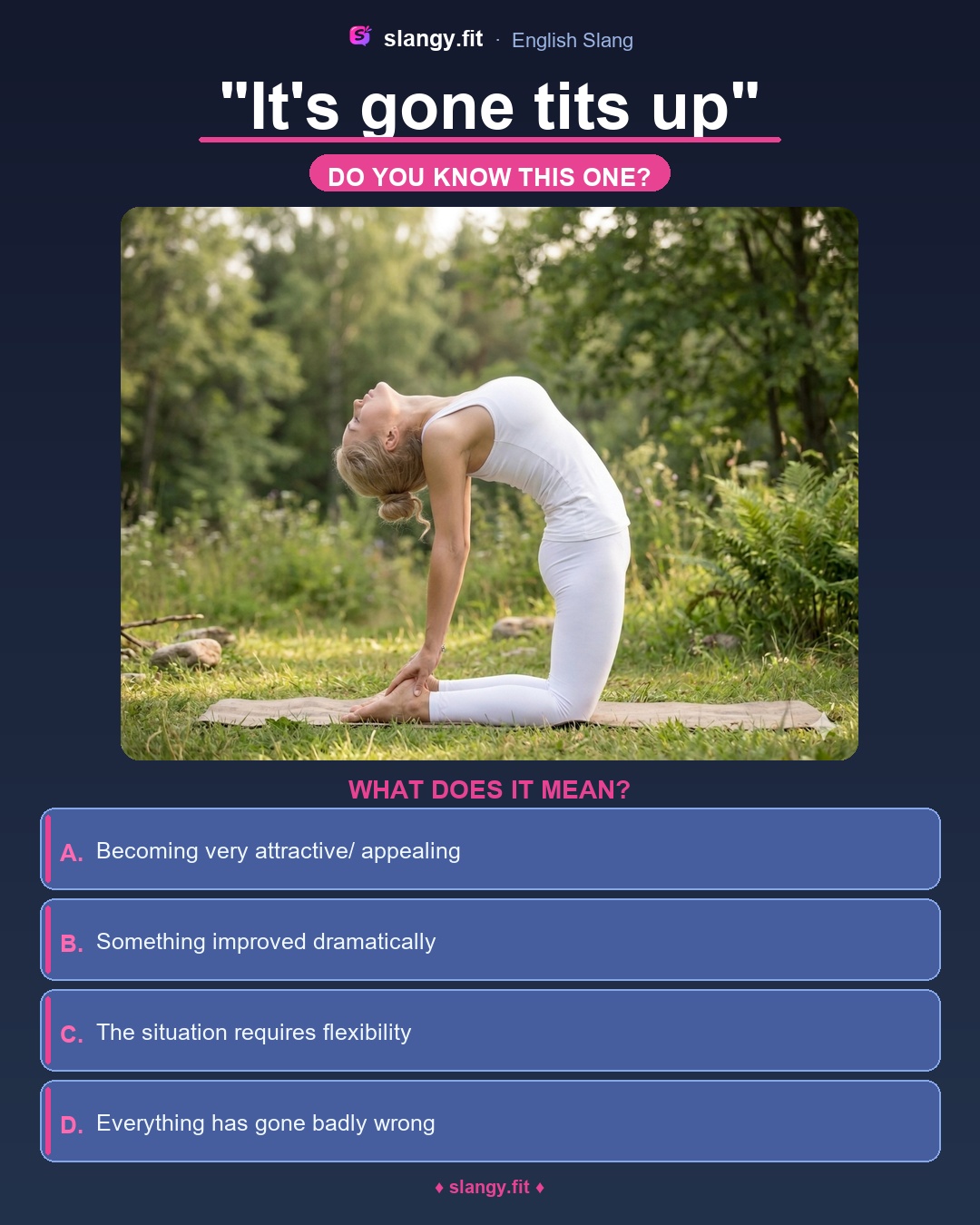
Here's one of the expressions you'll find — a very British way of saying everything went wrong:
Because in a world drowning in slop, the most radical thing you can build is something that helps two people actually understand each other.
Originally published on Medium.
It's gone tits up
Before you read on — can you guess what it means?
✅ It means…
Everything has gone badly wrong
💡 What it means
Literally it paints a crude image of something ending up upside down, like an animal lying on its back.
In practice it means a plan has gone badly wrong or completely failed. It's informal and pretty vulgar, so it's best kept for close friends, not work emails or polite company. It's especially common in British English, often said with dark humor when things fall apart.
🗣️ When to use it
Your road trip plan collapses when the car breaks down, the hotel cancels, and it starts pouring rain.
💬 Example
"The whole project's gone tits up-our supplier bailed at the last minute."
Watch this expression in action
Video available on the full expression page
Want to actually learn these?
Master these expressions with quick interactive exercises. Free to start.